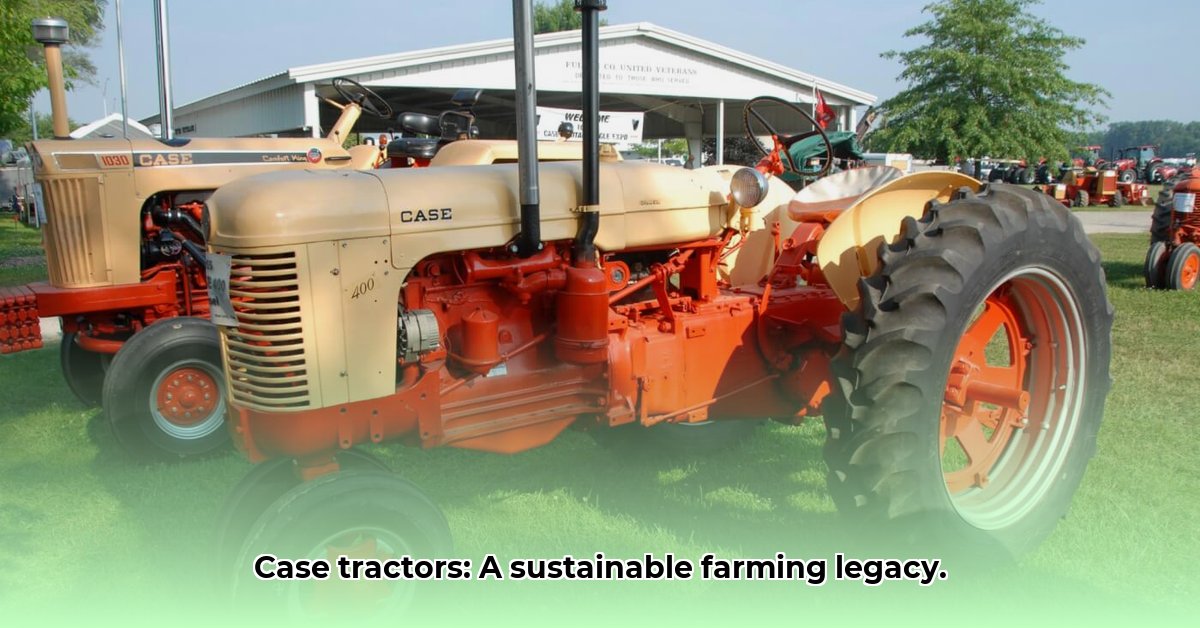
Let's embark on a journey through time, exploring the evolution of Case tractors and their profound impact on sustainable farming practices. From the behemoths of steam power to the high-tech marvels of today, we'll uncover the innovations, challenges, and environmental considerations that have shaped this iconic brand. This journey reveals not only remarkable progress but also highlights the ongoing pursuit of truly sustainable agriculture. For a similar look at historical agricultural equipment, see this helpful resource on tractor model history.
The Early Days: Titans of the Field
Imagine a world before widespread electricity, a landscape dominated by the rhythmic chug of steam-powered tractors. These early Case machines were far from the sleek, efficient models we know today. They were often cumbersome and required considerable manual labor. Picture massive boilers, complex moving parts, and clouds of coal dust! Fuel efficiency? That wasn't a primary concern; sheer power was paramount. While precise fuel consumption data for these early models is scarce, it's safe to say their fuel economy wasn't a strong suit. Yet, these early machines, testaments to human ingenuity and farmers' perseverance, were instrumental in revolutionizing agriculture. Detailed model year information from this era is incredibly challenging to obtain—a testament to the difficulties of historical research relying on scattered records and the passion of dedicated enthusiasts. Finding such data requires a significant research endeavor.
The Case IH Merger: A New Era
The 1985 merger of Case and International Harvester to create Case IH marked a watershed moment, uniting distinct engineering approaches and manufacturing traditions. Did this immediately translate into a strong focus on sustainability? Not precisely. While the merger undoubtedly boosted production and efficiency, the initial years didn't witness a drastic shift toward environmentally friendly farming. However, the combined resources and expertise laid the groundwork for future advancements in sustainable technology. This merger serves as a crucial turning point in the Case tractor narrative, setting the stage for subsequent innovations.
Technological Advancements and the Rise of Sustainability
Tracing Case tractor history reveals a gradual but significant move towards sustainable practices. The latter half of the 20th century brought considerable improvements. More efficient diesel engines replaced their less fuel-efficient predecessors, and electronics began to revolutionize operation. Electronic controls offered enhanced precision, potentially reducing fuel waste. However, precise emissions and fuel savings data from this period are often elusive. Standardized reporting wasn't common practice, leaving much historical data fragmented and inaccessible. This makes comparing models across decades a challenging task. While progress was undeniable, the full extent of sustainability gains in this era remains somewhat shrouded in the fog of incomplete records.
Here's a simplified overview, acknowledging the limitations of data availability:
| Decade | Key Technological Advances | Sustainability Improvements (Qualitative) | Data Challenges |
|---|---|---|---|
| 1960s-1970s | Increased horsepower, improved gearboxes | Minimal; focus primarily on output | Extremely limited, fragmented records |
| 1980s-1990s | More efficient diesel engines, early electronic controls | Gradual fuel economy improvements; emission data scarce | Limited and often proprietary data |
| 2000s-Present | Advanced electronics, precision farming, emission controls | Significant fuel efficiency and emission reductions; improved data | Still patchy, but increasingly more accessible data |
Modern Tractors: Embracing a Greener Future
Today's Case IH tractors stand in stark contrast to their steam-powered ancestors. Modern machines boast advanced engine management systems optimizing fuel use and minimizing emissions. Precision farming technologies—GPS-guided planting and spraying, for example—enable farmers to use resources far more efficiently, minimizing waste and optimizing yields. However, the quest for perfect sustainability continues. Case IH, alongside other manufacturers, is actively pursuing zero-emission tractors, recognizing the urgent need to reduce agriculture's environmental footprint. Electric and alternative-fuel tractors are on the horizon, paving the way for cleaner farming practices. Significant hurdles remain, nevertheless, including high costs, the need for supportive infrastructure, and limitations in current technology.
The Path Forward: Innovation and Sustainable Agriculture
The future of Case IH tractors, and the broader agricultural machinery sector, hinges on a steadfast commitment to sustainability. Future generations of farmers will demand equipment minimizing environmental impact without compromising efficiency. Research into alternative fuel sources like hydrogen and the refinement of electric powertrains are essential. Creating a sustainable agricultural sector requires concerted effort from manufacturers, farmers, researchers, and policymakers alike. The Case IH story reflects this ongoing journey—a journey characterized by both remarkable innovation and the persistent work needed to build a greener future for farming. The journey toward truly sustainable agriculture remains an ongoing process. How can we further accelerate this vital transition?
Key Takeaways:
- Early Case tractors, while innovative, lacked the fuel efficiency of modern models.
- The Case IH merger significantly impacted subsequent technological advancements and fuel efficiency.
- Decades of innovation have resulted in dramatically improved fuel efficiency and reduced emissions.
- Modern Case IH tractors prioritize sustainability with features promoting efficient resource use.
- Comparing fuel efficiency across model years requires a nuanced understanding of technological change and data limitations.